
Prof. Charlotte Doidge, Prof. Jasmeet Kaler and Abbie-Louise Smith.

A new study from the University of Nottingham School of Veterinary Medicine and Science, led by Prof. Charlotte Doidge, examines an increasingly important question in AI-moderated research: Do AI-generated follow-up questions simply generate more text, or can they uncover genuinely new insights?
The answer appears to be both.
The research examined public perceptions of dairy calf health in the UK, a topic unfamiliar to most respondents and often involving ethical considerations.
A total of 296 UK participants completed an AI-moderated survey on the Glaut platform. The survey included six researcher-designed open-ended questions, each followed by a single AI-generated follow-up question. Participants could respond via voice or text.
The researchers compared initial responses with the combined responses generated after AI probing using three measures:
The addition of a single AI-generated follow-up question increased average response length from 41 words to 71 words. That represents a 75% increase in verbosity.
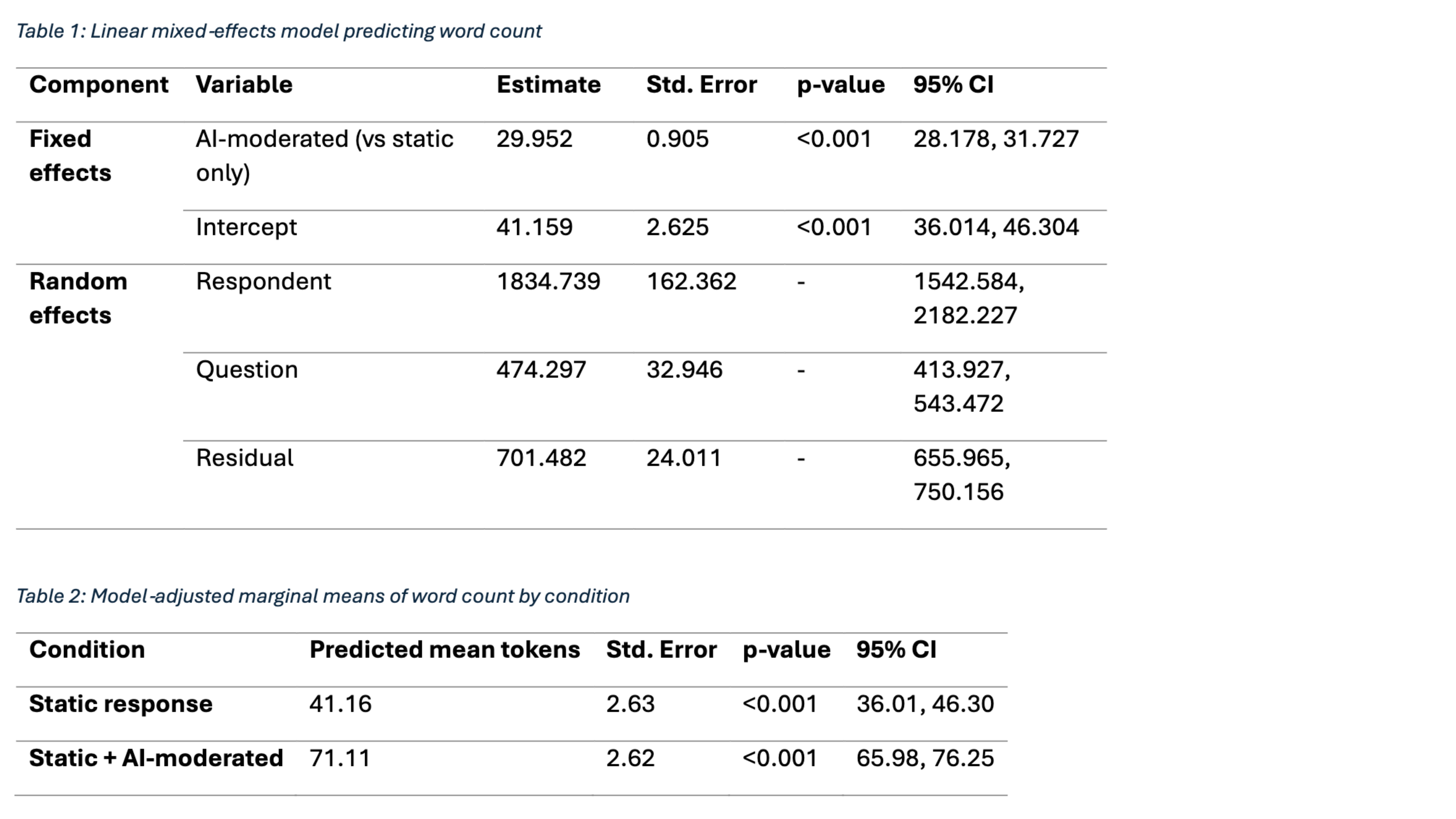
This finding aligns with previous AIMI studies showing that dynamic follow-up questions encourage respondents to expand on their answers. What makes this result notable is that it was replicated in a specialized domain where most participants had limited prior knowledge.
To determine whether respondents were adding meaningful content, the researchers measured lexical diversity, which captures the richness and variety of vocabulary used. The addition of AI-generated follow-up questions increased lexical diversity by 9%.
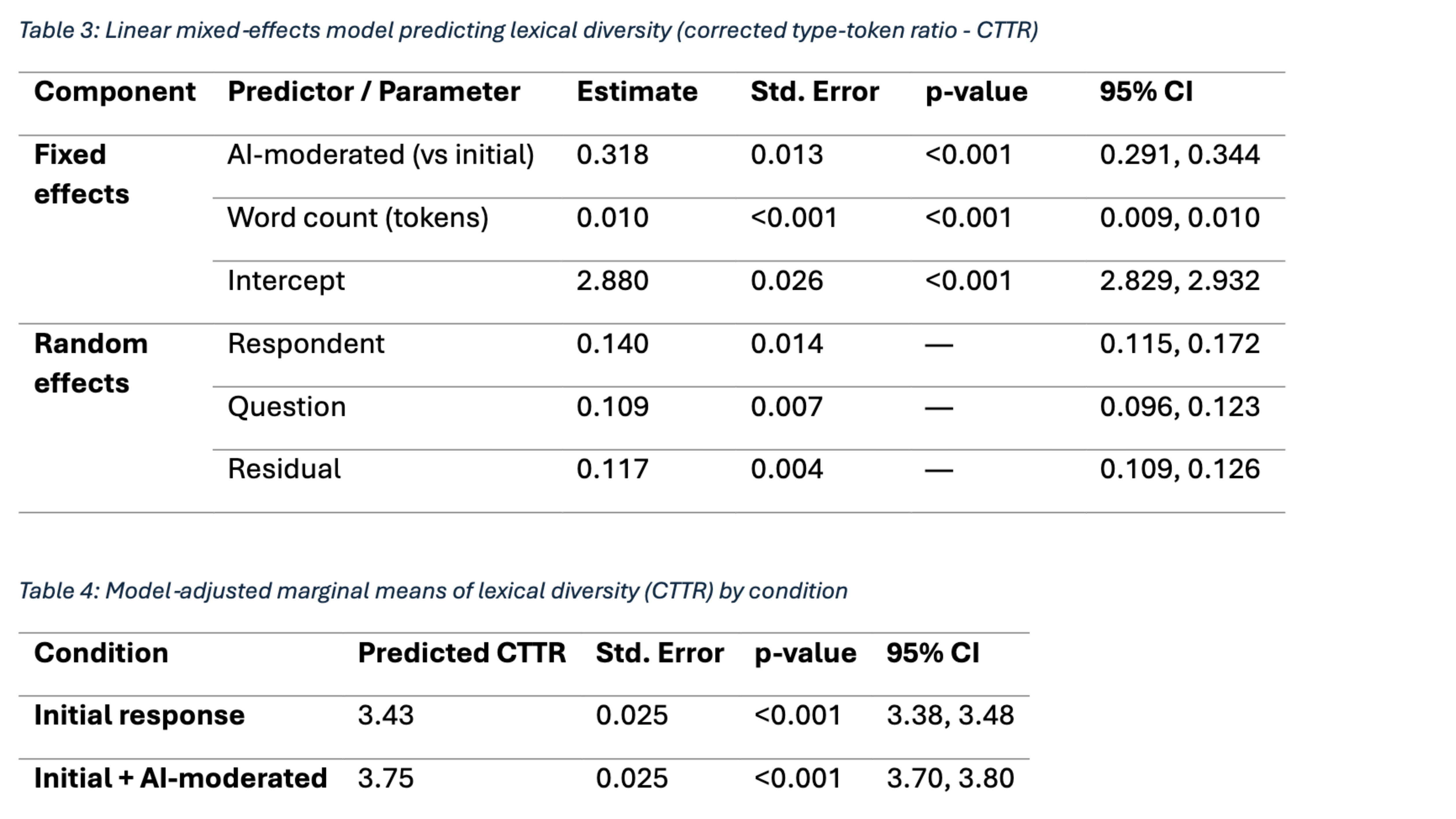
In practical terms, respondents were introducing new concepts and language rather than restating what they had already said. This mirrors findings from previous AIMI research and provides further evidence that AI moderation can encourage deeper reflection rather than simple repetition.
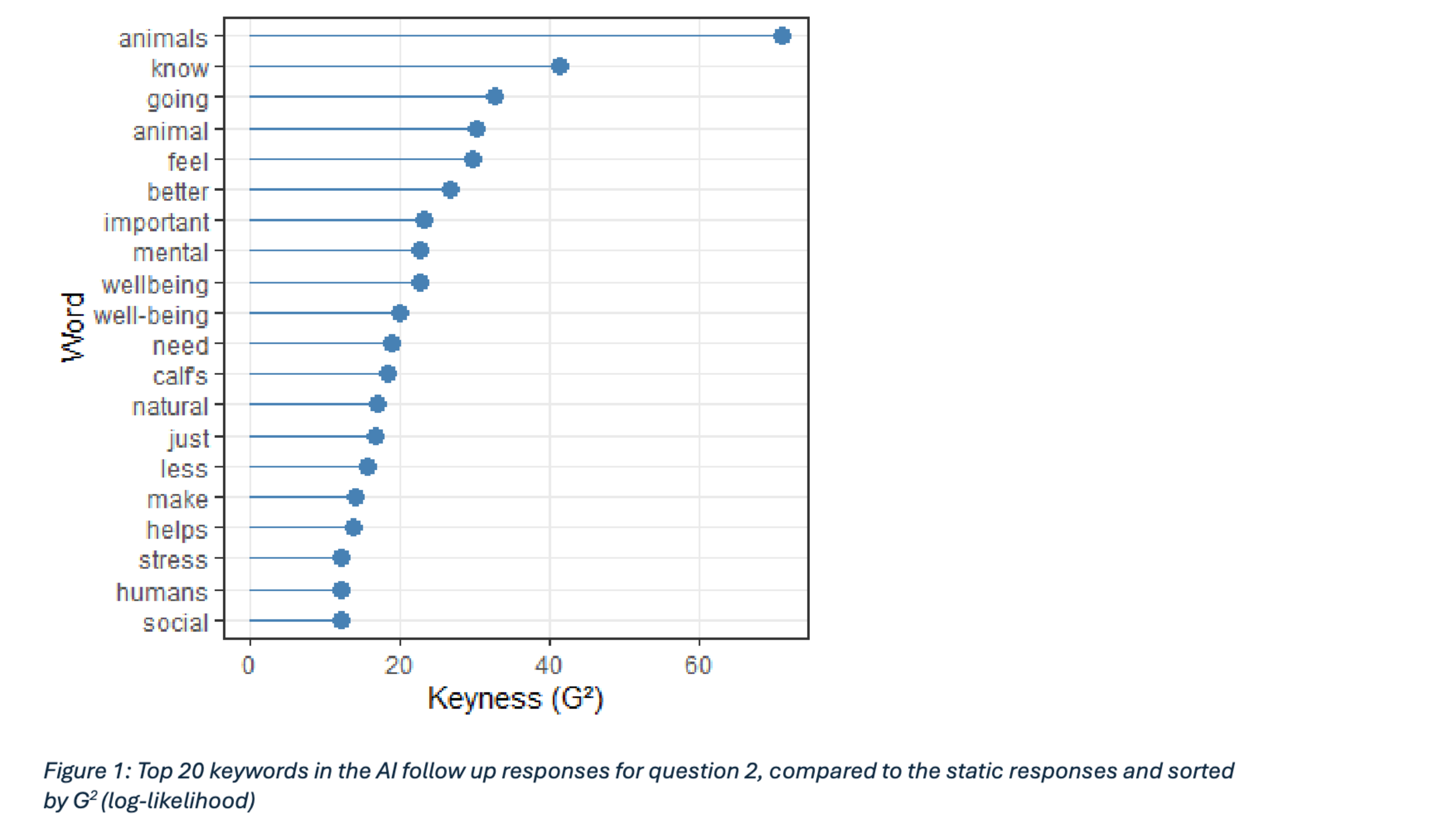
Using keyness analysis, the researchers examined whether AI-generated questions introduced topics largely absent from the original responses.
In several cases, they did.
When respondents were asked what a good life for a dairy calf looks like, AI follow-ups generated significantly more discussion around:
Only 10 respondents mentioned these topics in their original responses. After AI probing, that number increased to 110 respondents.
When discussing who is responsible for ensuring calf welfare, AI-generated follow-ups surfaced substantially more discussion around:
Nutrition-related themes increased from 48 respondents to 150 respondents, while environmental themes increased from 6 respondents to 81 respondents.
AI follow-ups also prompted respondents to think beyond the UK context. References to other countries increased as participants began comparing welfare standards across different regions. Taken together, these findings suggest that AI-generated follow-up questions can help respondents explore dimensions of a topic that were not immediately salient in their initial answers.
When respondents were asked highly specific questions or had already explained their reasoning in the initial response, AI probing often reinforced existing answers rather than uncovering new themes. For example, questions about specific calf management practices elicited very little thematic expansion, as respondents had already articulated their reasoning in the original question. This finding reinforces a broader lesson emerging across AI-moderated research: AI moderation is only as effective as the combination of researcher-authored questions and AI instructions.
Based on their findings, the authors suggest that AI-generated follow-up questions work best when:
AI-generated follow-ups are less informative when:
Previous AIMI studies have demonstrated that AI moderation can generate longer responses and richer language. This study extends that evidence by showing that AI-generated follow-up questions can also uncover new themes, particularly when respondents are discussing unfamiliar topics and when the research design gives the AI room to explore new directions.
The findings suggest that the future of AI-moderated research is not simply about replacing static questionnaires with dynamic conversations. It is about designing the right combination of researcher-authored questions and AI-generated probes to help respondents articulate ideas they might not otherwise express.
As the authors conclude: “the success of AI moderation depends not only on the technology itself, but on how researchers design the conversation around it”.
Notes:
Collect, analyze, and report research from any source with more depth, speed, and control.
Schedule a free demo